Skip to content2nd place · Pro category · International Astromobile Rover Competition
ROVIK-1 / ROVSSA · Case study · 2026
From software to real movement.
I was responsible for software development for ROVIK-1. I built ROVSSA, the ground control station connecting the operator to the rover and displaying telemetry. The data transmission system worked during the competition.
My responsibility
Software development
Environment
Linux · Jetson Nano · LAN
Team result
2.º / Pro · IAA
ROVSSA: cameras, telemetry and mapping in one console. Project screenshot with location details redacted.
01 / The challenge
See what the rover sees. Understand what is happening.
A remotely operated vehicle needs an interface that brings its data together and helps the team monitor its state. The challenge was to integrate software, communications and hardware in a prototype built by a multidisciplinary team from UNSa and UCASAL in Salta, Argentina.
My contribution
Development of the web control station and telemetry transmission system.
Work with Python and Flask to connect the interface with the rover system.
Use of Linux, SSH and local networks during integration and testing.
Collaboration with the electronics and mechanical team to integrate software with the prototype.
MVP scope
Telemetry transmission was successfully used during the competition. The console brings together camera views, orientation, sensors, mapping and rover controls.
AI navigation was not implemented. Later experimental modules are not part of the results demonstrated in competition.
Rover hardwarePico · USB serial Sensors and cameras
The interface receives telemetry through Server-Sent Events (SSE), sends HTTP commands and displays MJPEG video. On the Jetson, Python coordinates communication with sensors and devices. The Pico integration uses serial communication.
This architecture describes the reviewed code. Competition telemetry is the confirmed operational result; the experimental repository version requires separate validation.
The work extended beyond the screen: software development had to support vehicle construction, component assembly and team testing. These images document the working environment and prototype development.
Prototype assembly work. Project archive.Team integration work on the rover. Project archive.
04 / Results and demonstrations
An international second-place award.
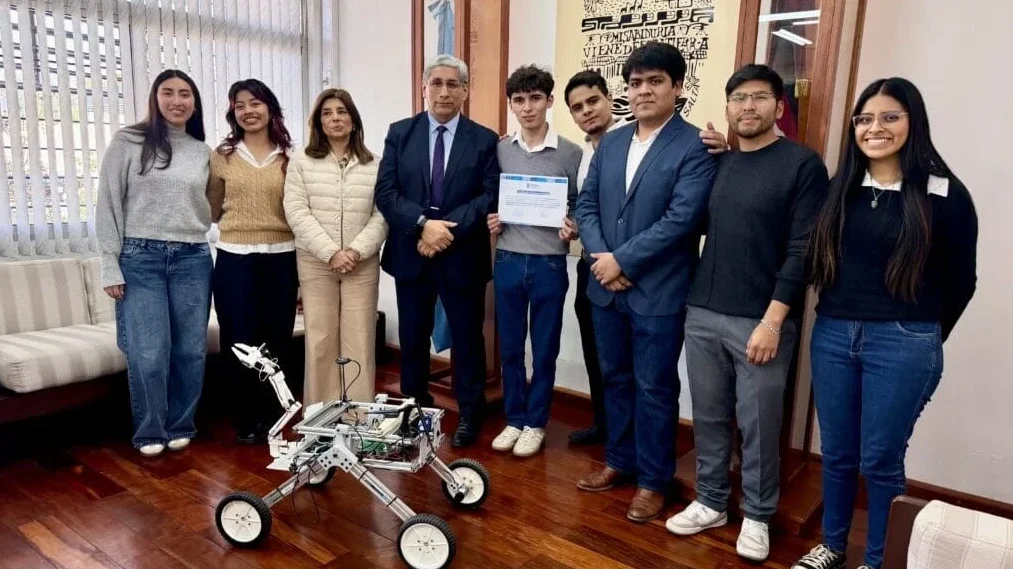
ROVIK-1 earned second place in the Pro category of the International Astromobile Rover Competition, held during the 2nd Latin American Conference on Space Science of the International Academy of Astronautics (IAA). This was a team achievement; my responsibility was software development.
The integration provided hands-on experience in web development, Python, Linux and hardware communications. It also opened a next stage of security review: the prototype code uses HTTP to transport commands and telemetry over the local network.
IMPROVEMENT PLAN · IMPLEMENTATION AND VALIDATION PENDING
HTTPS / TLS
The next proposed improvement is to add TLS and verify server certificates to protect data in transit. Authentication, access to control channels and behavior during connection loss also need review.
These changes have not yet been implemented or tested on the rover. Hardware validation is pending until the equipment becomes available again.